You love your sport. Maybe it is a Saturday morning round, a club team that keeps you competing, or the season your teenager has worked toward for years. Then your back tightens on the downswing, your shoulder pinches during a throw, or a hamstring grabs you mid-sprint, and everything stalls.
If you have already tried physical therapy and felt rushed, handed off to an aide, or sent home with a generic handout, your frustration makes sense. You deserve a plan built around your body, your sport, and your goals. That is exactly what performance and golf physical therapy in Bethesda, MD can look like when it is done right.
What Is Golf and Performance Physical Therapy?
Performance physical therapy goes beyond calming pain. It looks at how you move, how much force you can produce and absorb, and where your body is leaking power or overloading a joint. Then it builds a plan to fix those limits and prepare you for the demands of your sport.
Golf physical therapy applies that same thinking to the swing. The golf swing asks your hips, spine, shoulders, wrists, and core to work in a tight sequence at high speed, often hundreds of times per week between range sessions and rounds. If one link is stiff, weak, or poorly coordinated, another area pays the price.
At Elevated Strength Rehab, our approach blends hands-on care, progressive strength training, and objective testing. You are not just treated until you feel better. You are trained until you are ready.
Common Golf Injuries and What Drives Them
Golfers are often surprised to learn how physical the sport is. Research on golf injuries consistently points to the low back as one of the most commonly injured areas, followed by the elbow, shoulder, wrist, and hand. Many of these problems trace back to how your body moves, not just how your club moves.

Low Back Pain
The swing combines rotation, side bending, and rapid acceleration. When your hips or upper back do not rotate well, your lower back often takes over that motion. Over time, that extra load can lead to stiffness, spasms, or pain that lingers after a round.
Golfer's Elbow
Golfer's elbow is pain on the inner side of the elbow where forearm tendons attach. It is often tied to repetitive gripping, forceful impact, and limited strength or control through the forearm and shoulder. Treatment works best when it addresses the tendon and the movement habits that keep irritating it.
Shoulder Pain
Rotator cuff irritation and shoulder impingement can show up when shoulder blade control, upper back mobility, or rotator cuff strength fall behind the demands of your swing. The shoulder rarely works alone, so we look at the whole chain from your trunk to your hand.
Hip Pain
Limited hip rotation can restrict how well you load into your backswing and rotate through impact. Hip impingement (FAI), labral irritation, and general hip tightness can all affect how your swing feels and how your lower back and knees respond.
Wrist and Hand Pain
Your wrists and hands handle the shock of contact and control the clubface. Pain here can come from grip tension, repetitive strain, or weak forearm muscles. Good care looks at both local tissue health and the mechanics upstream.
How a TPI Assessment Shows What Is Holding Your Swing Back
Elevated Strength Rehab is Titleist Performance Institute (TPI) certified for golf physical therapy. TPI testing is a structured way to connect your physical limits to your swing patterns, so you stop guessing about why you slice, lose distance, or feel sore after 18 holes.
During a TPI-based screen, we look at areas such as:
Hip rotation and lower body mobility
Thoracic spine (upper back) rotation
Shoulder and arm mobility
Core stability and balance
Single-leg control and overall movement quality
The goal is a clear picture of which physical limitations may be affecting your swing and which ones may be contributing to pain. From there, your Doctor of Physical Therapy builds a program of mobility work, stability training, and strength training that targets your specific limits. Better movement gives you more options in your swing and less stress on your body.
Objective Testing: Measure Progress Instead of Guessing
Feeling better is a great start, but it is not the same as being ready. That is why testing is built into your care. Objective numbers show you where you started, what is improving, and what still needs work.
Force Plate and VALD Testing
Force plate and VALD testing measure how you push into the ground and how well you load, jump, land, and balance. This can reveal side-to-side differences and power gaps that are hard to see by eye. These measurements help guide your training and let you track change over time.
Isokinetic and Dynamometer Testing
Isokinetic and dynamometer testing measure muscle strength in a controlled way. After an injury like an ACL tear or hamstring strain, these results help show whether your injured side is keeping up with the other side.
Movement Screens and Return-to-Sport Testing
Movement screens highlight patterns that may raise your risk of injury or limit performance. Return-to-sport testing then checks your strength, power, control, and confidence with sport-specific demands before you go back to full play. For athletes and parents, that means decisions based on data, not just a calendar.
Performance Physical Therapy for Athletes Beyond the Course
Golf is a major focus, but the same performance mindset supports many athletes and active adults. We work with high school and college athletes, club sport participants, weekend warriors, runners, and parents who want advanced rehab for their athletic kids.
Depending on your goals, your plan may support:
Return to sport after injuries such as ACL tears, meniscus injuries, ankle sprains, and hamstring strains
Return to running with attention to load, strength, and mechanics
Injury prevention and prehab before a season starts
Strength building to improve power, durability, and confidence
Post-surgery rehab that progresses from early recovery to sport readiness
Overuse injuries and tendinopathy such as runner's knee, Achilles tendinopathy, and tennis elbow
If you are juggling pain with a demanding schedule, you can also explore our services to see how performance training, recovery services, and physical therapy fit together.
The Treatments We Combine to Get You Moving Again
No single technique fixes everything. Your plan is built from several tools, chosen for what your body needs at each stage.
Manual therapy: Joint mobilization, soft tissue mobilization, myofascial release, and trigger point therapy can help reduce pain and improve motion so you can move and train more effectively.
Dry needling: A thin needle is used to target tight, irritable muscle tissue. Many people use it to help reduce pain and improve how a muscle moves.
Cupping: Suction cups are applied over muscle and soft tissue to help ease tension and support mobility.
Progressive strength training: Your program gradually builds load, power, and control so your tissues can handle sport again.
Blood flow restriction (BFR): A cuff partially limits blood flow during light-load exercise. Research supports BFR as a way to build strength when heavy loading is not yet appropriate, such as early in rehab.
Neuromuscular re-education and balance work: These drills retrain coordination, balance, and body awareness so movement feels controlled and automatic.
Plyometrics and return-to-sport progressions: Jumping, landing, cutting, and rotational drills prepare you for real game speed.
When helpful, supportive options such as compression therapy or electrical stimulation can be added to your plan.
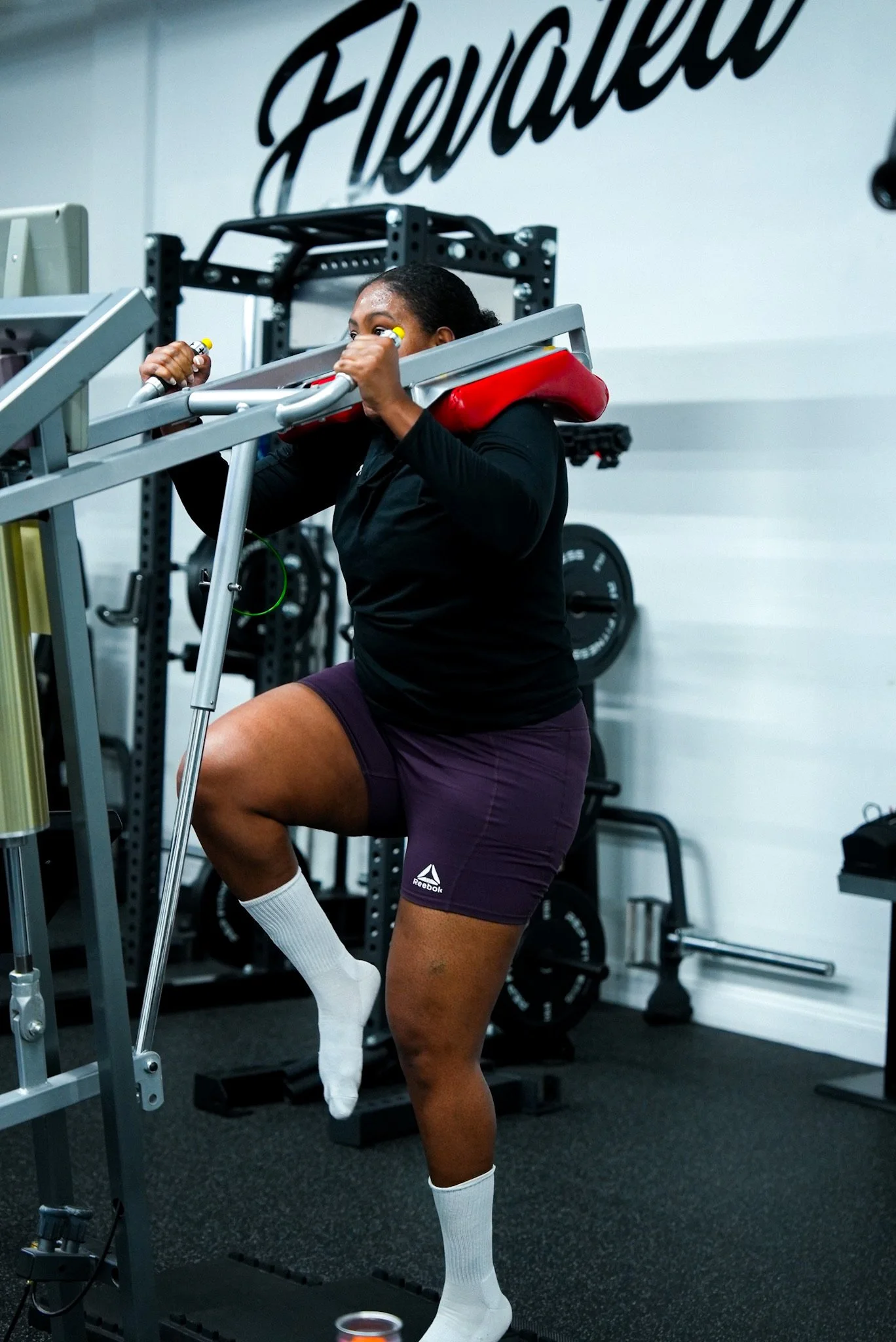
The 4 R's of ESR: Our Framework for Lasting Results
Every plan at Elevated Strength Rehab follows the 4 R's of ESR. This framework keeps your care organized and moving forward, so you always know where you are and what comes next.
Re-set
We calm irritated tissue, reduce pain, and restore basic motion. Manual therapy, dry needling, cupping, and gentle movement help create a better starting point.
Re-learn
Next, we retrain how you move. Neuromuscular training, balance work, and targeted exercises help you replace compensations with efficient patterns, whether that is a hip hinge, a golf rotation, or a landing mechanic.
Re-load
Now we build capacity. Progressive strength training and BFR, when appropriate, rebuild strength, power, and endurance. Testing helps confirm that your gains are real and measurable.
Re-engage
Finally, we bring you back to what you love. Sport-specific drills, plyometric progressions, and return-to-sport testing prepare you for the course, the field, or the court with confidence.
What Makes Elevated Strength Rehab Different
Many people come to us after feeling like a number in a crowded clinic. We built our model to change that. Here is what you can expect:
60-minute, one-on-one sessions exclusively with a Doctor of Physical Therapy
No aides and no double booking, so your full session belongs to you
No referral needed — Maryland is a direct access state, so you can book directly
A free 15-minute discovery call to ask questions before you commit
Specialized expertise in golf PT, ACL rehab, sports performance, and arm care for throwing athletes
Two locations in Gaithersburg and Bethesda
We are also a minority-owned practice committed to personalized, doctoral-level care. You can read more about our story and approach on our About page.
What to Expect at Your First Visit
Your first visit is designed to give you answers and momentum. It starts with a real conversation about your history, your pain, your sport, and what you want to be able to do again.
Next comes a full movement assessment. Depending on your goals, that may include a golf-specific TPI screen, strength testing, or movement analysis to find the true drivers of your problem. Your Doctor of Physical Therapy then explains what they found in plain language and builds a personalized plan around it.
You will not leave with a vague promise. You will leave knowing what is going on, what the next steps are, and what to start doing at home. Treatment can often begin right away, so your recovery starts on day one.
Frequently Asked Questions
Do I need a referral to start physical therapy in Bethesda?
No. Maryland is a direct access state, which means you can see a physical therapist without a physician referral. You can book directly or start with a free 15-minute discovery call.
Is golf physical therapy only for people who are injured?
Not at all. Many golfers come in to improve mobility, build strength, or address swing limitations before pain begins. A TPI-based assessment can help you train smarter and reduce the strain your body takes on the course.
Can my teenager see you for sports rehab or performance work?
Yes. We work with student and youth athletes, including high school and college competitors. Parents often appreciate the objective testing, since it gives clear information to guide return-to-sport decisions.
How long will I need physical therapy?
It depends on your injury, your goals, and how your body responds. Your plan is individualized, and your Doctor of Physical Therapy will outline expectations after your assessment and update them as you progress.
What should I wear and bring?
Wear comfortable athletic clothing that lets you move freely and allows access to the area being treated. If you play golf, bring your sneakers or golf shoes and let us know about any swing concerns, pain patterns, or past injuries.
Ready to Elevate Your Game and Your Recovery?
You do not have to settle for pain, rushed appointments, or a plan that was never built for your sport. With one-on-one time, advanced testing, and a clear framework, you can move better and get back to the activities that matter most.
Reach out to Elevated Strength Rehab in Bethesda today to schedule your free 15-minute discovery call or book your first visit. Visit our home page to get started.